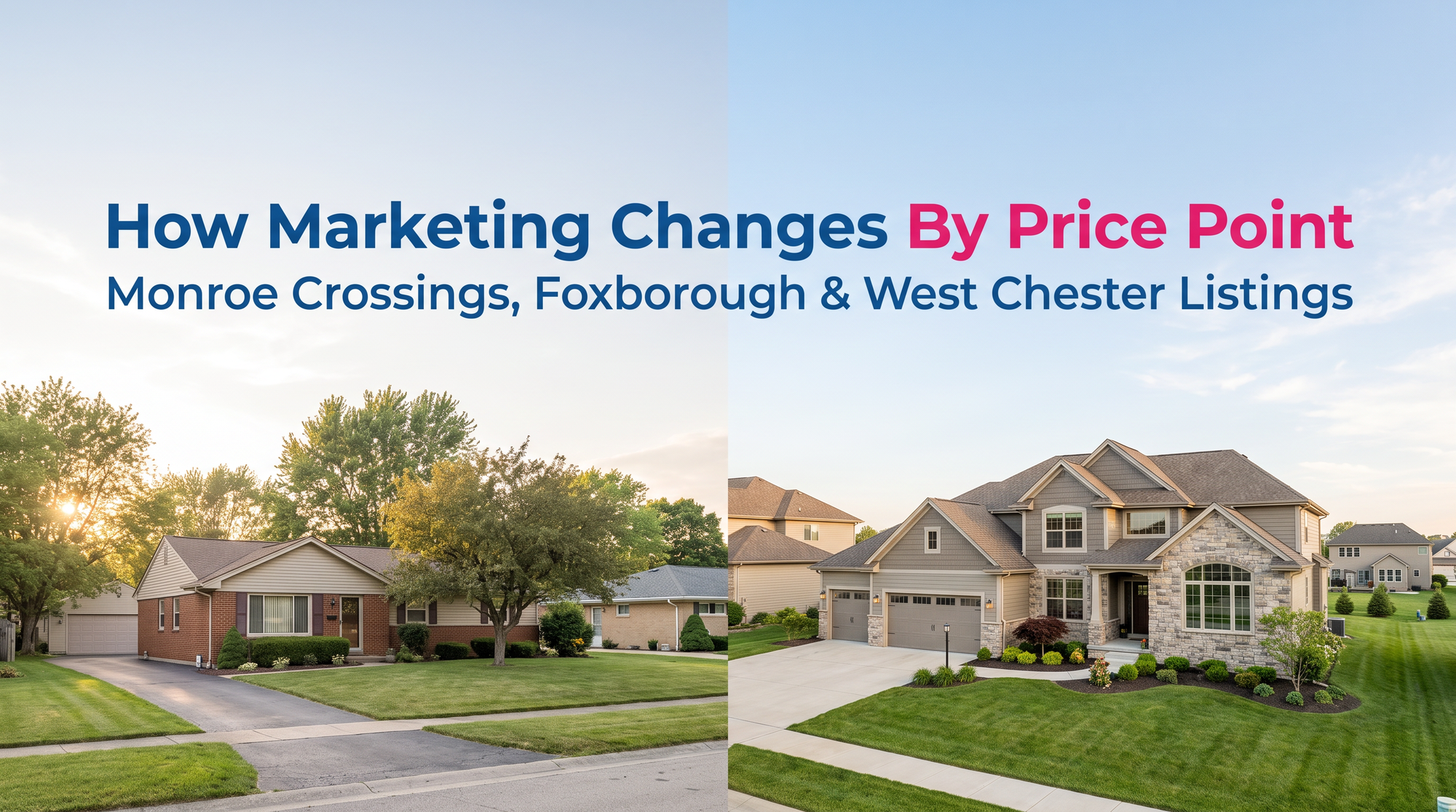

Why Foxborough and Shaker Run Sellers Need a Targeted Marketing Strategy — Not a Generic One

If you've sat through two or three listing appointments, you've probably noticed the marketing plans start to blur together. Professional photos. Listed in the MLS. Syndicated everywhere. A social post. An open house.
Here's the part nobody says out loud: it's usually the same plan that agent would run on a $280,000 ranch two townships over. That isn't wrong — it's built for the middle of the market, and if you own a home in Foxborough or Shaker Run, the middle of the market is not where your buyer lives. Whether Foxborough and Shaker Run sellers need a targeted marketing strategy instead of a generic one is the right question to ask before signing anything, and the answer is yes — for reasons that have less to do with effort than with math.
The Buyer for a Foxborough or Shaker Run Home Isn't the Median Buyer
Ohio's median sale price sat around $274,000 in May 2026, with a median 43 days on market, per Redfin's published Ohio market data. Monroe's citywide median has been running in the mid-$300s; Warren County's is closer to $395,000. Homes in Foxborough and Shaker Run trade in the $550,000 to $900,000+ range — not a little above the median, but a different conversation, where the pool of qualified buyers in a given season may be a few dozen households, not a few thousand.
In NAR's 2025 Profile of Home Buyers and Sellers, repeat buyers made up 79% of the market, put down a median of 23%, and 30% paid all cash. The typical repeat buyer was 62.
Translate that into a Saturday showing. The person in your kitchen has bought and sold before, brought an experienced agent, and isn't stretching to afford your house — so they aren't desperate to win it. They're comparing you to three others, and they'll wait. That buyer responds to precision, not volume. It's why we walk sellers through what a $600K–$1M listing should expect from their agent before we ever talk about price.
Generic Marketing Optimizes for Volume. Your Home Needs Precision.
A volume-based plan makes a reasonable bet: put the home everywhere, and enough of the right people will stumble across it. In a high-traffic price band, that usually pays. At $650,000 in a specific community, it breaks down. If forty households in the region are shopping your profile this quarter, you need to reach those forty — and you need to be the home they remember. "Everywhere" doesn't do that.
That's the difference between a marketing plan and a marketing strategy. A plan is a list of tasks; a strategy starts with a specific buyer and works backward.
What Targeted Marketing Actually Looks Like in These Neighborhoods
Our 150+ point marketing plan runs on every listing regardless of price. What changes here is emphasis.
Copy and photography built around the actual differentiator. Buyers at this level aren't comparing square footage. They're comparing lot position, natural light, the finished lower level, whether the primary suite is on the main floor. Someone who wants a walkout on a private lot needs to know within eight seconds that you have one.
3D tours for the buyer who isn't local yet. Many buyers here are relocating into the corridor or moving up from Cincinnati and Dayton suburbs, and they screen online first. A Wow Video 3D tour is often what earns a spot on a weekend shortlist.
Outreach that treats neighbors as a channel. We plan two open houses per listing with door-hanger invitations into the surrounding streets, plus Just Listed postcards. In established communities, the buyer is often someone a neighbor knows — the same logic behind getting a Shaker Run home onto every buyer's short list.
Reverse Prospecting: Finding the Buyer Instead of Waiting for One
Most listing marketing is passive. You publish and you hope. Reverse prospecting flips it: from the MLS side, we identify the agents whose clients have saved searches matching your home, then reach out directly, one at a time. With thousands of matches that's impractical — but at a $700,000 Foxborough or Shaker Run profile, the list is short enough to work through, which is what makes it valuable here. We break down the mechanics in our look at why reverse prospecting changes how we find buyers.
Most agents skip it — not because it's secret, but because it takes hours and doesn't fit on a slide.
Pricing and Marketing Are the Same Conversation
Targeted marketing doesn't rescue a price that's out of position, and it isn't meant to. Your comp set here is narrow — often six to ten genuinely relevant sales, not sixty. That makes pricing more precise, not less, and small errors get expensive fast. A generic approach averages a wide radius of "similar" homes, which is how a Shaker Run home ends up benchmarked against something that shares a ZIP code and nothing else.
Our position is the one we bring to every seller: we own the marketing, you own the pricing — but none of us are buying the house, so we want to price it to lead the market, not chase it. Days on market carries a real penalty up here. Every week you get performance data through List Trac and Beacon — views, clicks, showings, feedback — so any adjustment we recommend arrives with evidence attached.
What This Looks Like in Practice
Consider a couple in their late fifties listing a home in the mid-$700s to move into a ranch closer to family. Two prior agents suggested opening above $800,000 "to leave negotiating room."
A targeted approach looks different. We'd start with the narrow comp set and price to lead it. Scott would walk the property first and flag the two or three items an inspector will find, so they're handled on the sellers' terms rather than as a defect-notice negotiation later. Photography waits until prep is done, and reverse prospecting starts the day it goes live.
The point isn't a promised outcome. It's that every decision was deliberate — for this house, in this neighborhood, for this buyer.
Frequently Asked Questions
Why do Foxborough and Shaker Run sellers need a targeted marketing strategy instead of a generic one?
The buyer pool at this price point is small, experienced, and comparison-driven. Broad exposure assumes a volume of casual shoppers that doesn't exist above the median.
Isn't the MLS enough? Everything syndicates anyway.
Syndication gets your home listed; it doesn't get it noticed, and it misses buyers who haven't started searching yet. Neighborhood outreach, reverse prospecting, and 3D tours reach people the MLS alone won't.
Does better marketing mean I can list at a higher price?
No, and we'd be careful with any agent who suggests otherwise. Marketing controls how many qualified buyers see your home; buyers still set the price. It protects a well-chosen price — it doesn't validate one the market won't support.
How long should I expect my home to be on the market?
Typically longer than the corridor median, because fewer buyers exist for any premium home. That's normal and planned for. What matters is whether showing activity is building.
What should I ask an agent to prove they have a real strategy?
Ask what they'd do differently for your home than for a $300,000 listing. If the answer is "more of the same," that's a volume plan.
Where to Start
A generic marketing plan isn't lazy — it's calibrated for a different house than yours. In Foxborough, Shaker Run, and Monroe Crossings, the difference between a plan and a targeted marketing strategy shows up in the final number.
If you're early in the process, a current read on what your home is worth today is the right first step — not a 2021 comp or a portal estimate, but an actual look at your narrow comp set.
If you're thinking about selling in Foxborough, Shaker Run, or anywhere across the Cincinnati–Dayton corridor, we'd be glad to walk through it with you. No pitch, no pressure — just a straight conversation about what will protect your equity and position your home to lead the market.
Scott and Jill Ferguson are REALTORS® with Spouses Who Sell Houses at Real Broker. The information in this post is intended for general educational purposes and reflects market conditions as understood at the time of publication. Individual results vary. Consult a licensed real estate professional for advice specific to your property and situation.
Categories
Recent Posts