
What "Local Expertise" Actually Means — And Why It Changes Your Sale Outcome in Monroe, Mason, and Lebanon

When you're interviewing agents to sell your home, almost every one of them will tell you they know the area. They'll say they've worked in the market, they know the neighborhoods, they understand what buyers want. And technically, most of them aren't lying.
But there's a meaningful gap between an agent who has sold homes in your zip code and one who knows your specific street, your subdivision's buyer profile, the price point where absorption slows, and which prep decisions will actually move the needle for your particular home. That gap doesn't show up in a bio. It shows up in your final number at closing — and in how smooth or complicated the process feels between now and then.
Here's what genuine local expertise looks like, and why it matters more in communities like Monroe, Mason, and Lebanon than the phrase usually suggests.
It Starts With Understanding How Each Community Actually Behaves
Monroe, Mason, and Lebanon are all within a 20-minute drive of each other. They're often grouped together as part of the broader Cincinnati–Dayton corridor. But they are not the same market.
Monroe has seen notable momentum in recent years. Homes there were selling at a median of around $437,000 in mid-2025, with days on market compressing significantly — averaging closer to 29 days compared to 45 the year before. That kind of shift tells an experienced local agent a lot: buyer demand is outpacing inventory, well-prepared homes are moving quickly, and pricing strategy needs to be sharp to capture that energy rather than stall above it.
Mason is a different story. It carries strong school district appeal, a higher price point — median home values hovering around $498,000 to $511,000 depending on the source — and a longer, more deliberate buying cycle. Homes there were averaging closer to 42 days on market in recent data. Buyers in Mason tend to be methodical. They're comparing multiple options, they're running their own research, and they'll notice if your home's condition or presentation is even slightly behind the competition. That context changes how you price, how you prepare, and what your marketing needs to accomplish.
Lebanon occupies its own distinct space. It has a small-town character that genuinely appeals to a specific type of buyer — often someone relocating from a denser suburb or making a lifestyle move. Median prices around $340,000 to $405,000 (recent data varies by quarter) and a somewhat slower pace than Monroe or Mason means the buyer pool is narrower. Reaching the right buyer — not just any buyer — becomes the work. That's where marketing strategy and local knowledge intersect in ways that matter.
An agent who treats these three communities as interchangeable is starting from the wrong place.
Neighborhood-Level Knowledge Is Where It Gets Specific
City-level data tells part of the story. Neighborhood-level knowledge tells the rest.
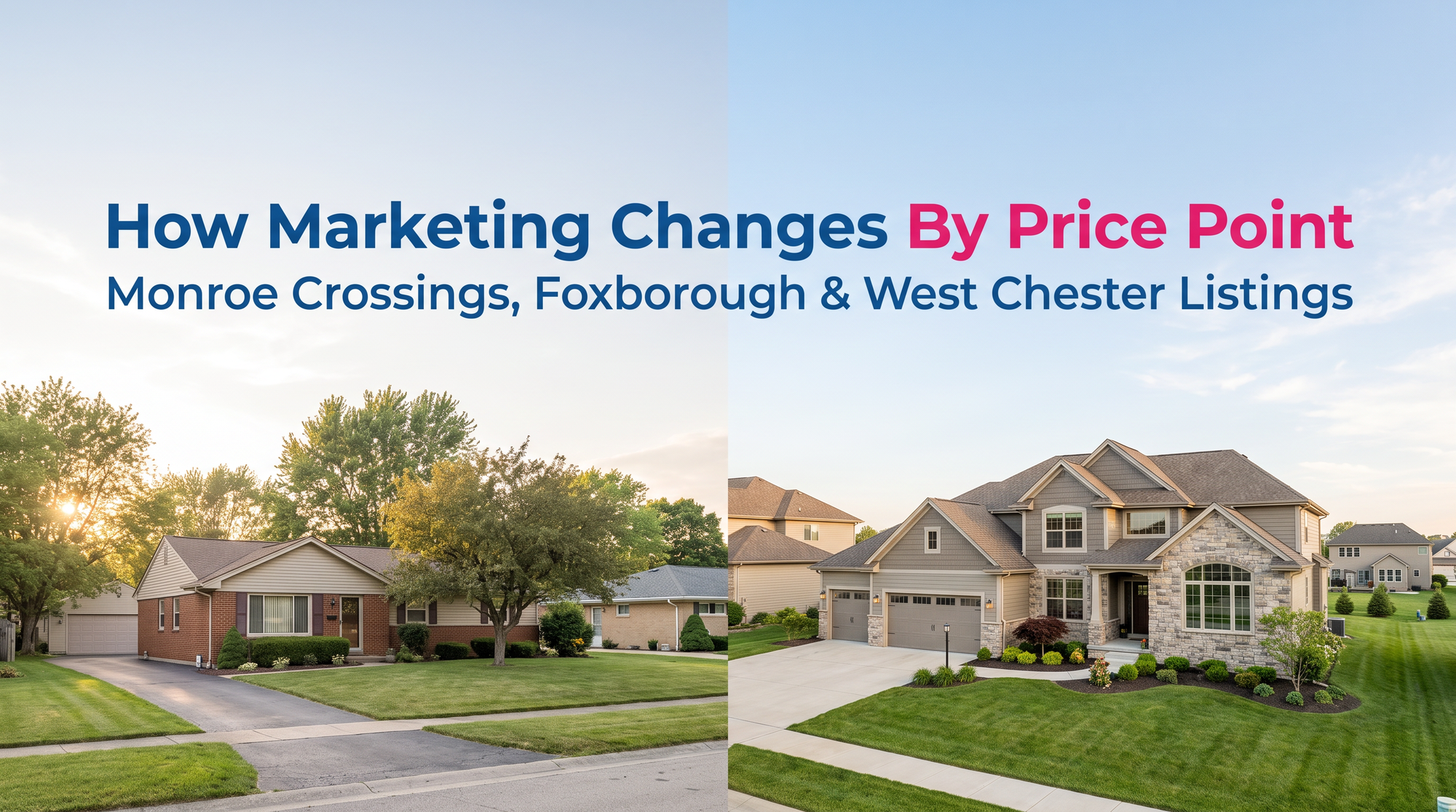
In Monroe Crossings, for example, the buyer profile skews toward move-up families and established professionals. Presentation standards are high. Open houses with targeted neighborhood outreach — door-hanger invitations, not just a sign in the yard — tend to generate meaningfully more traffic than passive promotion alone. Knowing that isn't something you read in a market report. It comes from selling homes there, attending open houses there, and understanding what makes buyers in that specific community write offers.
Foxborough, in the West Chester area, has its own rhythm. Shaker Run attracts buyers who are specifically seeking the lifestyle the neighborhood offers — the golf, the community feel, the price point that sits above the median but below the luxury threshold. Knowing how to position a home in Shaker Run means understanding who is looking there, where they're coming from, and what they're comparing your listing to.
This kind of neighborhood fluency affects everything from how a home is photographed and described to which buyers your agent proactively reaches out to before the listing even goes live — a strategy called reverse prospecting, which involves identifying buyers already registered in the MLS whose search criteria match your home's profile. An agent without local depth may not even know to look.
Local Expertise Means Pricing From the Ground Up — Not Down From a Wish
One of the most expensive ways local knowledge (or the lack of it) shows up is in pricing.
An agent without genuine local depth often leans on broad regional comps or — worse — outdated sales data from years when the market was behaving very differently. They may suggest a number that feels good in the listing appointment but doesn't reflect where today's buyers in your specific community will engage. The result: price reductions, extended days on market, and a stigma that follows the listing even after it's corrected.
We use current local data — recent sales, active competition, days on market trends, and buyer behavior in your specific price range and community — to arrive at a price that's designed to lead the market rather than chase it. That phrase matters. "Leading" means you're positioned ahead of buyer expectations at launch, which creates urgency and often multiple offers. "Chasing" means you start high, sit, reduce, and eventually settle for less than you would have gotten with the right strategy from day one.
For a seller in Monroe, that pricing conversation looks different than it does for a seller in Mason or Lebanon — because the data, the buyer behavior, and the competitive inventory are all different. Understanding those distinctions isn't a bonus. It's the job.
You can explore what your home might realistically be worth in today's market using our free home valuation tool — a useful starting point before any conversation with an agent.
What Preparation Decisions Actually Pay Off (And Which Ones Don't)
Local expertise also shapes the pre-listing advice you receive.
In communities like Monroe Crossings or Mason, buyers at the $450,000–$600,000 price point have high expectations around first impressions — online and in person. Professional photography, compelling copy, and a clean, market-ready presentation aren't optional at that level. But knowing which prep investments generate real ROI and which ones are spending for the sake of spending takes local pattern recognition.
We've seen sellers spend thousands updating a kitchen before listing, only to discover that buyers in their price range were planning to renovate anyway and didn't assign extra value to it. We've also seen a seller who painted, decluttered, handled a few deferred maintenance items, and professionally staged — net result: a quicker sale, stronger initial offers, and a cleaner inspection process.
Scott's background in construction and inspections adds a specific layer here. Not just in terms of what to address before listing, but in understanding what a buyer's inspector is likely to flag — and how to handle those findings strategically when they arrive, rather than reactively. For sellers in any price range, knowing how inspection negotiations typically unfold in this market (and having an agent who can hold a position with data and experience behind them) is worth more than most sellers realize until they're in the middle of one.
What This Looks Like in Practice
A seller in Monroe reached out to us after having a home sit on the market for several weeks with another agent. The listing had generic photos, a description that could have applied to any house in the area, and a price that was reasonable on paper but wasn't supported by the specific comp set within that subdivision.
After a reset — new photography, updated pricing that reflected both the Monroe momentum and the specific competitive inventory in that price band, and a relaunch with direct outreach to buyer agents who had active clients in that range — the home was under contract within two weeks.
Nothing about the house changed. The local strategy did.
That's the story behind "local expertise" at its most practical: not a claim, but a set of decisions that only make sense if you actually understand the market you're working in.
If You're Thinking About Listing in Monroe, Mason, or Lebanon
The questions worth asking any agent before you sign aren't just about experience. They're about depth. Do they know what buyers in your specific neighborhood are prioritizing right now? Can they show you the data behind their pricing recommendation — current data, not data from a stronger year? Do they have a clear, specific plan for how your home will be marketed and to whom?
If the answers feel generic, they probably are.
If you're considering listing in Monroe, Mason, Lebanon, or anywhere in the Cincinnati–Dayton corridor and want a conversation grounded in what's actually happening in your specific community right now, we'd be glad to walk through your situation. No pressure, no obligation — just a clear, honest look at where you stand and what a smart path forward looks like.
Reach out here to start that conversation.
This post is intended for general informational purposes. Market data referenced reflects publicly available sources and recent MLS trends as of early 2026. Individual results will vary based on home condition, specific location, pricing, and market timing. This is not intended as legal, financial, or appraisal advice. Scott and Jill Ferguson are licensed REALTORS® with Real Broker (REAL of Ohio).
Frequently Asked Questions
What does "local expertise" actually mean in real estate? It means an agent knows your specific neighborhood's buyer profile, pricing patterns, days on market trends, and what prep decisions drive value — not just the general zip code.
Why do Monroe, Mason, and Lebanon sell differently? Each has distinct buyer profiles and price dynamics. Monroe moves faster with a lower median; Mason draws methodical buyers at a higher price point; Lebanon appeals to lifestyle-focused buyers in a narrower pool.
How does local knowledge affect my home's sale price? Agents with genuine local depth price from current, specific data — which typically means stronger initial offers, fewer price reductions, and cleaner closings.
What is reverse prospecting and why does it matter for sellers? It's a strategy where your agent identifies buyers already registered in the MLS whose criteria match your home — actively finding the right buyer rather than waiting for them to find you.
What should I ask an agent to verify their local expertise? Ask them to show you recent sales data in your subdivision, explain the current buyer profile for your price range, and describe specifically how they plan to market your home and to whom.
What Our Clients Say
"We'd spoken to two other agents before Scott and Jill. The difference was immediate — they knew exactly what was happening in our neighborhood, had real data to back up their pricing recommendation, and had a clear plan from day one. We felt like we were in good hands the whole way through."
— Move-up Seller, Monroe, OH (name withheld for privacy)
What Our Clients Say
"I asked Scott about pricing before we even committed to listing. He pulled up specific sales from our subdivision, walked me through what buyers were actually offering versus asking, and I understood immediately why his number made sense. That kind of local knowledge is why we chose them."
— Seller, Mason, OH (name withheld for privacy)
Categories
Recent Posts